



Greetings from Solana Beach,
The shift from September 30th to October 1st may be just a day, but it marks a turning point. Thanksgiving is only 50 days away, holiday plans are being negotiated, and snowbirds are packing up. Across the country, families and companies alike are reflecting on the year—what worked, what didn’t, and how to get it right in 2026.
At DLK, October is a significant month as we begin working on our annual client reporting, exploring how taxes can be effectively managed in conjunction with our clients’ investments, and, as always, focusing on meeting our clients’ investment objectives. One of our largest partners, The Charles Schwab Corporation, recently published an in-depth paper on the risks of market capitalization–weighted index investing. It’s a topic we’ve emphasized for years in the Quality Investment Report—so we couldn’t help but smile when Schwab echoed our long-standing message.
The gist? The S&P 500 may sound like a broad basket of 500 companies, but in reality, it’s dominated by just a few giants. The weighting is based on each company’s size—its stock price multiplied by shares outstanding—meaning the biggest names hold the greatest sway. It’s the labeling that leads consumers to believe they own 1/500th of each index constituent. But you don’t.
The Dow Jones Company has created and markets the two indexes which is no different than Skippy Peanut Butter offering you smooth or extra chunky, they are both Peanut Butter and the indexes both buy the same companies.
While Dow Jones offers different “flavors” of the same peanut butter, the proportions of each ingredient have shifted dramatically in this tech-driven market. The result looks less like diversification and more like concentrated orange juice. And who drinks concentrated orange juice?
Below is the closing paragraph of the Schwab report. We couldn’t have said it better ourselves.
Summary:
With the top handful of stocks in the S&P 500 accounting for an historically high share of total market capitalization and index returns, investors face a risk that market breadth narrows, and performance becomes overly dependent on a few dominant stocks. This dynamic can distort perceptions of market health, as index gains may mask underlying weakness among the majority of constituents. For individual investors, the risk is that portfolios tied closely to cap-weighted indexes become more vulnerable to company-specific or sector-specific shocks, reducing the benefits of diversification that broad equity exposure is meant to provide. – From Schwab Asset Management Sept 15, 2025.
As Schwab notes above, narrow market leadership raises real risks. It’s why our investment approach emphasizes quality, balance, and active attention to concentration risk.
Additionally, if you are interested in reading how the market cap weighted index allocates the companies it buys, you can find that information here. Below is a chart that falls in a picture is worth a thousand words category.
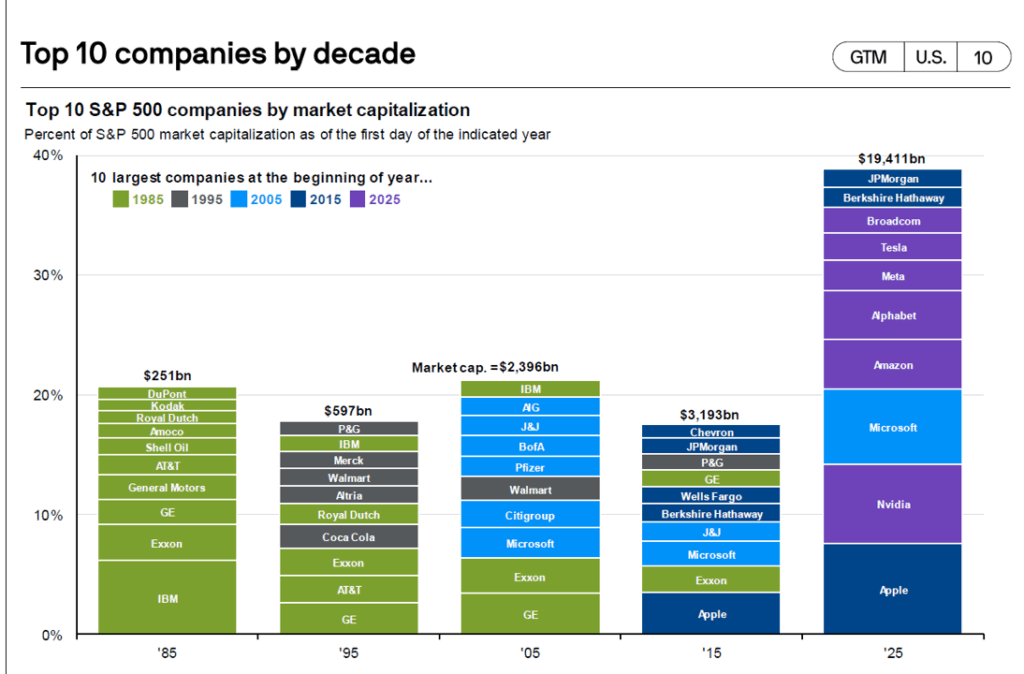
Source: Bloomberg, Standard & Poor’s, JPMorgan. Companies are organized from highest weight at the bottom to lowest weight at the top. Guide to the Markets – US Data areas as of Sept 30, 2025
Please email or call us with any questions you may have, we are honored to serve our clients and community and appreciate how powerful being financially prepared can be in retirement or when you are thinking about it.